Notice
-
News
Woongjin Establishes Malaysian Subsidiary, Targeting the Global Rental Solution Market
2025.06.20.
-
| Expanding local customer base through a Global Development Center (GDC)
| Strengthening service quality and local responsiveness through role-based collaboration across development, sales, and operations
| Second overseas subsidiary following the U.S. entity to accelerate global expansion and sustain revenue growth
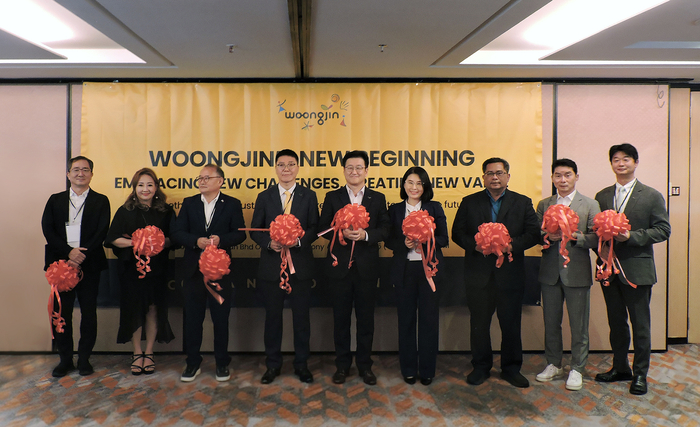
Suyoung Lee, CEO of Woongjin (fifth from left), poses for a commemorative photo at the opening ceremony held on June 17 at the Amari Kuala Lumpur Hotel in Malaysia.
Woongjin Co., Ltd. (CEO: Suyoung Lee) announced the establishment of its local subsidiary in Kuala Lumpur, Malaysia, marking the company’s official expansion into the Southeast Asian market.
An opening ceremony was held on June 17 at the Amari Kuala Lumpur Hotel, attended by Suyoung Lee, CEO of Woongjin, local executives from Korean companies including LG Electronics and SK Magic, as well as representatives from the Korea Trade-Investment Promotion Agency (KOTRA) Kuala Lumpur Trade Center, the Malaysian Korean Association, the Korean Chamber of Commerce Malaysia (KOCHAM), and the Association of Korean Alumni in Malaysia (AGIKO).
Malaysia is recognized as one of Southeast Asia’s most attractive markets for the rental industry due to its relatively high income levels and stable business environment, where major Korean companies actively operate rental businesses. Taking advantage of these market conditions, Woongjin plans to provide rental system using its proprietary solution, WRMS (Woongjin Rental Management System), targeting Korean enterprises operating in Malaysia as well as local rental companies.
WRMS is Woongjin’s independently developed platform that provides integrated support for all essential rental business functions, including contract management, billing, and customer management. Built on standardized core functionalities, the solution enables customers to selectively add features according to their industry requirements and operational models, delivering both efficiency and scalability. Woongjin has already proven its competitiveness by successfully completing system implementation projects for major rental companies in Korea.
The company also plans to build a global partnership ecosystem centered around its newly established Global Development Center (GDC) in Malaysia. Under this structure, Woongjin’s headquarters in Korea will oversee localization and R&D, overseas subsidiaries will manage technology, sales, and customer support, while partners will handle license reselling, implementation, and operations. Through this collaborative framework, Woongjin aims to strengthen both service quality and local customer responsiveness.
The Malaysian subsidiary represents Woongjin’s second overseas entity following its U.S. branch and holds strategic significance as a hub for Southeast Asian expansion and a key gateway for broader business growth across Asia. With strong growth potential in the rental industry and rapidly increasing demand for IT infrastructure, Malaysia is considered an optimal market where Woongjin’s core solutions and operational expertise can demonstrate maximum value. Through the launch of its Malaysian entity, Woongjin intends to further strengthen its position as a global B2B IT services company.
In his congratulatory remarks, Sung-gi Lee, Director General of KOTRA Kuala Lumpur, stated, “Woongjin’s expansion into the Malaysian solution business market comes at a highly opportune time amid growing demand for AI and cloud technologies. We hope this serves as an opportunity to further elevate the presence of Korean IT companies in the region.”
Jong-hwa Kim, President of the Malaysian Korean Association, commented, “The establishment of Woongjin’s local subsidiary reflects the company’s deep understanding of and preparation for the Malaysian market. The Korean community in Malaysia will continue to serve as a strong partner.”
CEO Suyoung Lee stated, “The Malaysian subsidiary will serve as our second headquarters for expansion across Asia, and this launch will mark another leap forward for Woongjin. We are committed to making meaningful contributions to both the Korean and Malaysian economies.”